Start by imagining the shot from a real tee position, at a realistic release height, with the intended landing zone in view. That simple change helps separate a meaningful challenge from a corridor that only looks dramatic from above. A design should make its question legible: shape the disc around an obstacle, select a landing area, control distance, or decide whether a higher-risk line is worthwhile. If the intended decision is unclear, the fairway may be narrow without being interesting.
Course design is a balance of challenge, variety, safety and site fit. No single width or geometry makes every hole fair. Player abilities, terrain, vegetation, prevailing conditions and the relationship to neighbouring holes all affect the result. The designer’s job is to define the intended challenge and examine the possible outcomes, not to claim that a corridor will suit every player or guarantee a particular score.
Read the line in cross-section
Map the flight space in more than one view. A plan view shows the horizontal path, while a cross-section helps reveal canopy, branches, elevation change and visibility. Identify the tee, likely release area, preferred flight, landing zone and plausible misses. Include both sides of the fairway. A line that rewards one shape but sends ordinary misses toward another tee or a public path demands further thought.
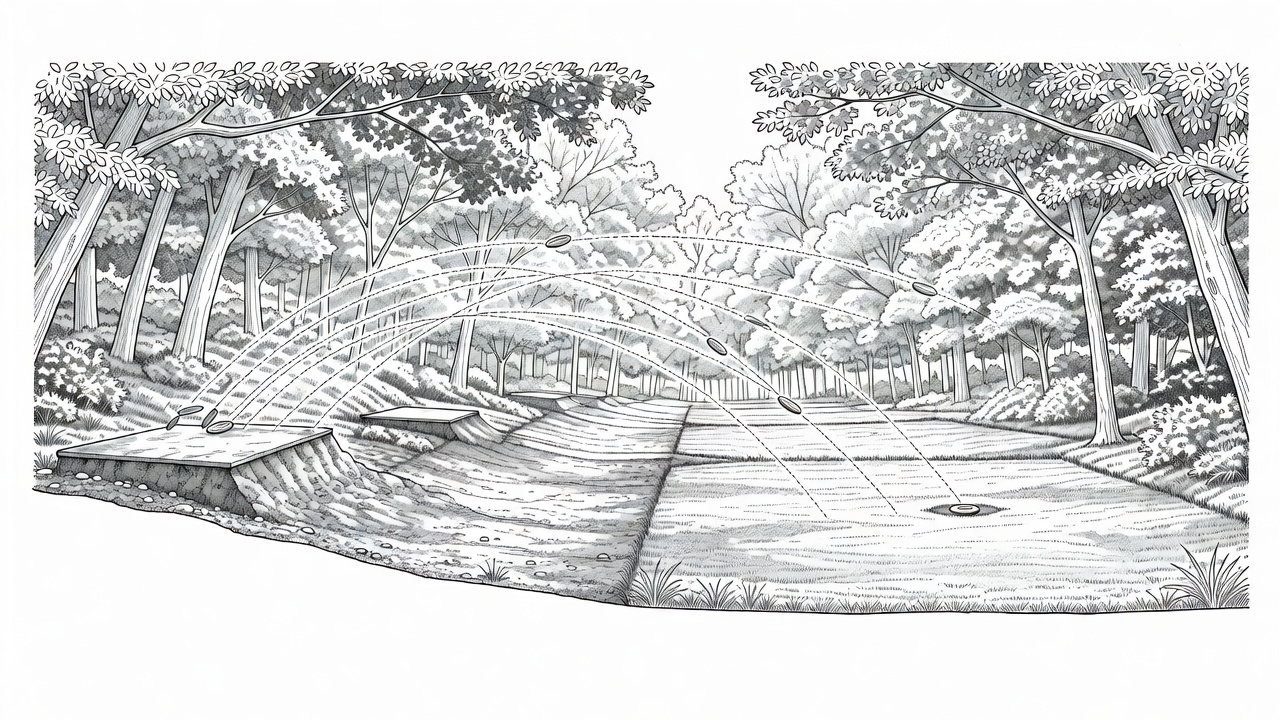
On site, take several positions behind the tee and note what is visible. Is the target apparent? Can the player see the landing area, or is the design asking them to throw toward an unknown? Some uncertainty can be part of a deliberate challenge, but hidden hazards and blind traffic are not a substitute for thoughtful design. Check how vegetation looks in different seasons and whether maintenance will preserve or alter the flight window.
Build a landing area with choices
A landing zone is a decision point, not just a patch of mown ground. Consider where a well-placed drive finishes, where a conservative throw might stop and what next shot those positions create. A broad area can still be strategically demanding when its surface, slope, tree placement or angle rewards one position over another. Conversely, a narrow landing strip can feel arbitrary if there is no visible reason for its exact width or if small errors have outsized consequences.
Look at the ground under likely landing spots. A slope can turn a seemingly safe landing into a long roll. Roots, rocks and uneven footing may make a recovery shot difficult or raise injury risk. Observe whether vegetation offers several playable routes or simply hides an unrecoverable lie. Players should be able to understand the intended choices before they throw wherever practical; if they cannot, make the uncertainty intentional and proportionate.
Give risk a readable consequence
Risk and reward work when the player can judge both. A more demanding line might shorten the approach or open a favourable angle, while a safer route may leave a longer or less direct shot. The alternative needs to be real, not a nominal route that is practically unusable. Review the likely outcome of a miss: a difficult but playable recovery is different from a lost disc, a dangerous roll toward people, or a forced throw across another group.
Try several representative throws rather than judging the corridor from one ideal shot. Test different release shapes, distances and levels of control. The purpose is not to prescribe a single “correct” throw, but to see whether the design supports a range of intentional play. Note where the course relies on a player hitting a tiny gap, where a miss is punished, and whether that punishment relates to the hole’s central question.
A corridor earns its narrowness when the player can understand the choice it creates.Flight-line fieldnote
Keep adjacent spaces in view
Every fairway sits within a larger pattern of movement. Mark neighbouring tees, baskets, expected landing zones and paths. Consider the full range of plausible throws, including an early release, an overstable finish and a shot that carries farther than expected. Do not judge separation only by the intended line. A diagram can make hazards look remote while field observation reveals that groups may meet at a blind turn or wait beside an active landing area.
Where trajectories could overlap, ask whether a modest shift to the tee, target or route can improve separation. Sometimes vegetation can help screen an adjacent hole, but a screen should not conceal an unsafe crossing or prevent players from seeing people. If redesign cannot reduce a conflict to a satisfactory level, a different hole concept may be wiser. No amount of skill expectation can make a fundamentally conflicting layout dependable.
Let vegetation have a purpose
Trees can define a line, frame a view, protect habitat and give a fairway character. Their role should be deliberate. Before removing or pruning vegetation, understand ownership, local requirements, ecological sensitivities and long-term management. A design that relies on a specific low branch may not last as the tree grows or as maintenance changes. Likewise, clearing a corridor too aggressively can erase the character and resilience that made the site valuable.
Record which vegetation is retained, which needs protection and what routine maintenance might be needed. Consider how sightlines change in leaf-off conditions, how a storm could alter the canopy and whether players will be tempted to create informal routes around a difficult obstacle. Observe those routes during testing: repeated footpaths are evidence about how people experience the design.
Test with varied players and conditions
Walk the corridor with people who throw different distances and shapes. Ask them what they see, where they intend to land and what a common miss would mean. Avoid prompting them with the answer. Their choices show whether the design communicates its challenge. Test in dry and damp conditions when possible, and after ordinary vegetation maintenance. A safe footing line in summer may be slippery under leaf litter or saturated soil.
Use field flags or temporary markers before final construction. Move them when a test reveals that the tee angle hides the landing zone, the approach conflicts with a path or the intended flight depends on a fragile branch. Record versions and observations so changes are traceable. A provisional line on the ground is cheaper to revise than a completed tee pad and permanent signs.
Corridor observation list
- What is the intended shot decision, and can players see enough to make it?
- Where do intended throws and plausible misses travel?
- What does the landing surface do to a disc and to a walking player?
- Could another group, path user or maintenance worker enter the flight area?
- Does the corridor remain understandable across seasons and routine upkeep?
A good corridor makes a clear promise: here is the challenge, here is the space in which to attempt it, and here are the consequences that follow. It need not be easy, but its difficulty should be legible and proportionate. Let the land contribute to the problem, then shape the playable space so the solution belongs to the player.